I'm a Machine Learning Engineer with hands-on research experience at DRDO (Ministry of Defence), where I built end-to-end ML pipelines for anomaly detection on quantum parameter records. I've published research at DHICON 2024 and IAC 2024, worked on multi-disease prediction systems, and developed neuroplasticity-inspired AI for autonomous spacecraft operations. Currently pursuing my Masters of Computer Application at DBIT, GGSIPU, building on a strong foundation from my BCA in Data Science with a CGPA of 8.86.
Portfolio
Hi, I'm Japanjot
ML Engineer & Researcher. I love building intelligent systems and solving real-world problems with data. Currently pursuing MCA at GGSIPU.
JS
About
Experience
DRDO — Ministry of Defence, India
Research Intern
September 2023 — February 2024
Built an end-to-end ML pipeline for anomaly detection using TensorFlow, improving predictive monitoring by 18% through feature engineering and model validation on 10,000+ quantum parameter records. Designed and executed experiments identifying 12 key parameter correlations, improving data interpretability by 20% and enabling data-driven decision-making for security protocols. Collaborated with stakeholders to translate business requirements into analytical solutions, achieving 97% data cleaning accuracy.
Research
Codsoft, India
Machine Learning Intern
June 2024 — August 2024
Built and deployed supervised ML classification models for fraud detection, churn prediction, and spam filtering on 10,000+ financial records, driving targeting precision and customer engagement optimization. Developed automated data pipelines using Python and SQL for feature engineering and model evaluation, reducing processing time by 30% and implementing A/B testing frameworks for performance measurement. Partnered with stakeholders to present model findings through Excel dashboards across 3 ML projects.
Education
DBIT, Guru Gobind Singh Indraprastha University
Masters of Computer Application (MCA)
2025 — Present

SGTBIMIT, Guru Gobind Singh Indraprastha University
Bachelor's of Computer Application — Data Science | CGPA: 8.86
2021 — 2024

Skills
Python
TensorFlow
PyTorch
Scikit-learn
NumPy
Pandas
SQL / MySQL
R
C++
HuggingFace
LangChain
RAG
Streamlit
Power BI
Tableau
Docker
REST APIs
Jupyter
Projects
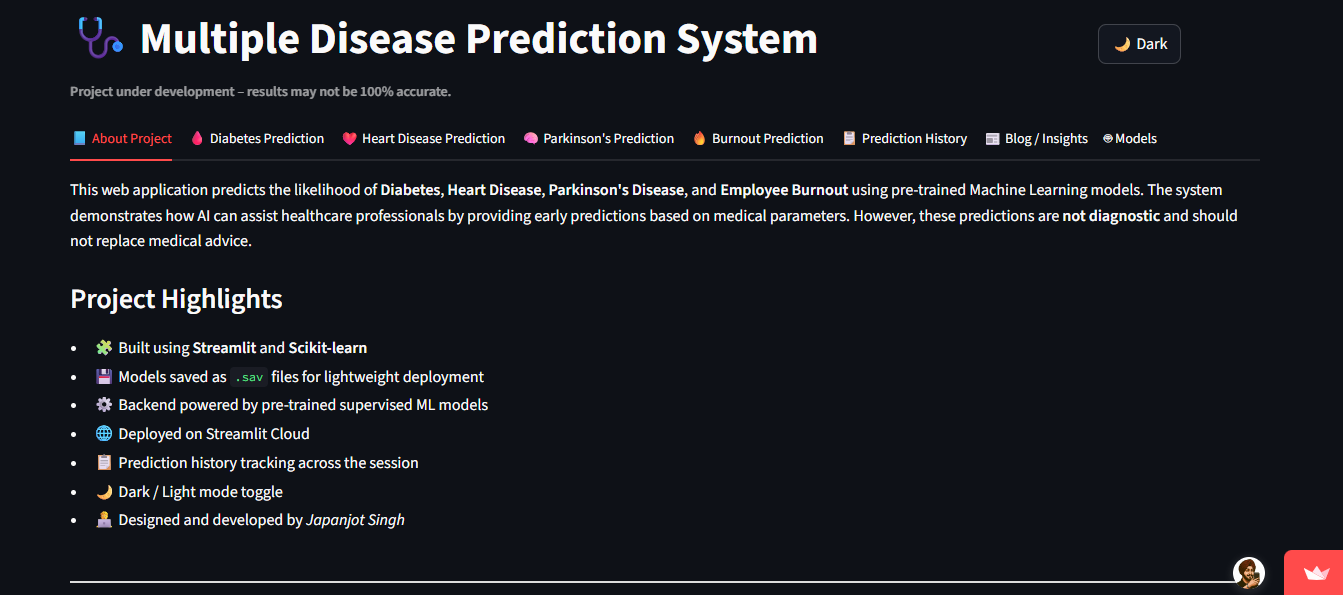
Developed a multi-class supervised learning system using Random Forest and SVM (Scikit-learn) for simultaneous prediction of diabetes, heart disease, and Parkinson's on 5,000+ healthcare records — improving accuracy by 15% through feature engineering. Built a Streamlit-based conversational analytics interface for real-time model inference and automated insights generation, processing 100+ requests per session and reducing decision-making time by 3 hours weekly. Implemented a model monitoring framework tracking precision, recall, and F1-score for continuous production optimization.
Python
Scikit-learn
Random Forest
SVM
Streamlit
Pandas
NumPy
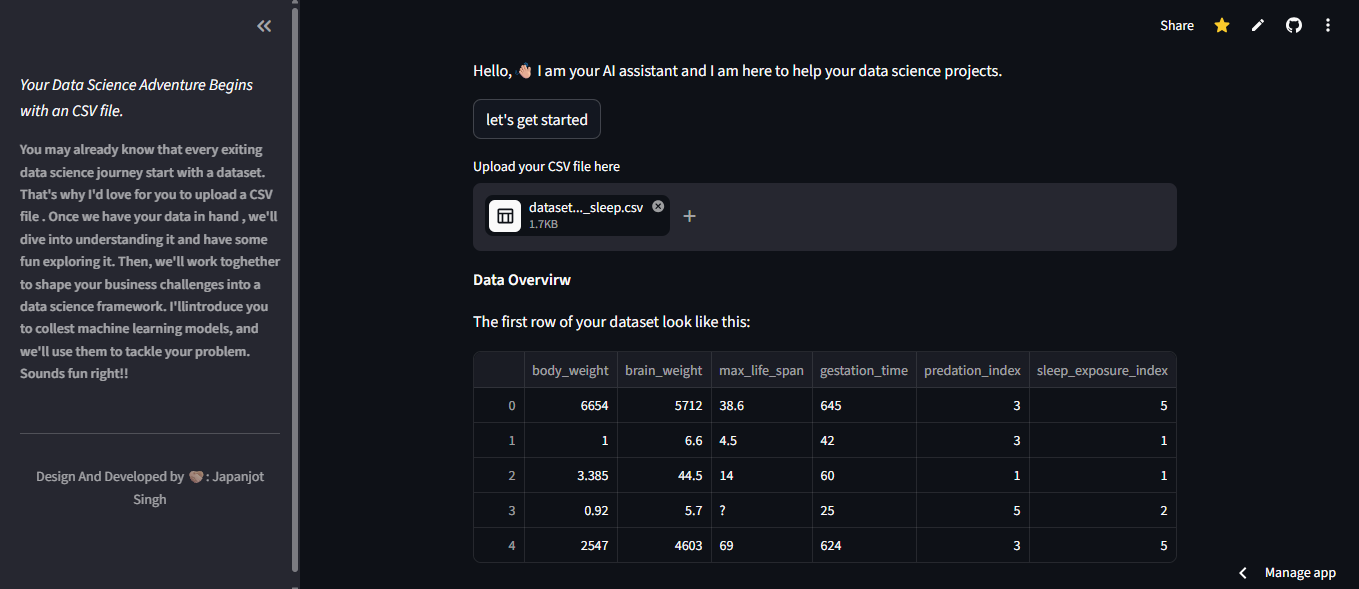
Built a smart Exploratory Data Analysis web app that automates data profiling from a single CSV upload — covering null detection, duplicate checks, correlation heatmaps, feature distributions, class balance checks, and automated HTML reports via YData Profiling. Powered by Streamlit for an interactive UI and processes datasets in milliseconds. Earned 8 GitHub stars from the data science community.
Python
Streamlit
YData Profiling
Pandas
NumPy
Matplotlib
Seaborn
Scikit-learn

Developed BCALabs, an academic resource platform designed for BCA students that centralizes study materials, lab manuals, programming resources, and exam preparation content in one place. The platform focuses on simplifying access to curated academic resources while maintaining a clean and responsive user experience. Built with modern web technologies to ensure fast performance, structured navigation, and easy content discovery for students.
Next.js
TypeScript
Tailwind CSS
Sanity CMS
Vercel
Blog
Publications
5 Publications · 4 Conference
A Comprehensive Study on Predictive Models for Parkinson's Disease
Japanjot Singh , Singh Sehajeet , Dr. Ashmeet Kaur
DHICON 2024
ConferencePublished
This paper presents a comprehensive comparative analysis of machine learning predictive models for early-stage Parkinson's disease detection. Using a multi-class supervised learning approach with Random Forest and SVM classifiers on clinical and biomarker datasets, the study identifies the most discriminative features for diagnosis. The proposed system achieved improved accuracy through feature engineering pipelines and cross-validation, contributing a reproducible framework for clinical decision support in neurodegenerative disease screening.
Parkinson's DiseaseSupervised LearningRandom ForestSVMHealthcare ML
Advanced Neural Monitoring and Radiation Protection System for Deep Space Exploration
Singh Japanjot , Singh Sukhjit
IAC 2024 — International Astronautical Congress
ConferencePublished
This paper proposes a neuroplasticity-inspired AI architecture for autonomous spacecraft operations in deep space environments where real-time human intervention is infeasible. The system integrates neural monitoring with adaptive radiation protection mechanisms, using sequence modeling and predictive pipelines to support mission-critical decisions across 10+ simulated scenarios. The framework demonstrated a 20% improvement in pattern recognition accuracy and a 15% reduction in signal processing latency over baseline approaches.
Deep SpaceNeural NetworksAutonomous SystemsRadiation ProtectionSpacecraft AI
A Review of Cloud Storage Architecture
Singh Japanjot, Sehajeet Singh Bindra, Dr. Ratandeep Kaur
International Journal of Innovative Research in Engineering & Management (IJIREM) — National Conference on Digital Transformation through Intelligent Computing Systems and Methods (NCDICM)
This paper presents a comprehensive review of cloud storage architecture and its role in modern data management systems. The study examines the evolution of cloud computing, key storage models, and architectural components including distributed file systems, service interfaces, and storage resource pools. It also analyzes different deployment models such as public, private, hybrid, and community clouds while discussing advantages like scalability, cost efficiency, and high availability. The review highlights the architectural layers of cloud storage and the technologies that enable secure, reliable, and efficient data storage in distributed environments.
Cloud ComputingCloud Storage ArchitectureDistributed SystemsData StorageScalable Infrastructure
A Systematic Review of ChatGPT Applications in Modern Business Environments
Singh Japanjot
National Conference on Corporate Social Responsibility and Sustainable Business, Sri Guru Tegh Bahadur Institute of Management and Information Technology (SGBTIMT), Delhi
ConferencePresented
This paper explores the growing role of generative artificial intelligence, specifically ChatGPT, in modern business environments. The study reviews how large language models can support organizational functions such as customer service, business analytics, marketing automation, and decision support. It evaluates the benefits of AI-driven communication systems in improving operational efficiency, scalability, and data-driven decision-making. The paper also discusses challenges including ethical considerations, data privacy, and reliability of AI-generated outputs, providing insights into the future integration of generative AI technologies in business ecosystems.
Generative AIChatGPTBusiness IntelligenceAI in BusinessDigital Transformation
A Unified Multi-Disease Prediction Framework Using Supervised Classification: Design, Evaluation, and Deployment Across Four Clinical Domains
Singh Japanjot, Deepika Kirti
Under Review (Submitted for Publication)
Research PaperUnder Review
This paper proposes a unified machine learning framework for predicting multiple health conditions within a single deployable system. The framework integrates supervised classification models to detect four clinically significant conditions: type 2 diabetes, coronary heart disease, Parkinson’s disease, and occupational burnout. Each module employs a classifier selected based on dataset characteristics, including Support Vector Machines for diabetes, Parkinson’s disease, and burnout prediction, and Logistic Regression for heart disease classification. The system incorporates tailored preprocessing pipelines, probability calibration, and physiologically bounded input validation to improve prediction reliability. Evaluation across held-out datasets demonstrates competitive performance with F1 scores ranging from 69.6% to 91.3%. The complete framework is deployed as a lightweight Streamlit web application enabling accessible multi-disease screening without external infrastructure.
Machine LearningDisease PredictionSupervised ClassificationHealthcare AIStreamlit Deployment